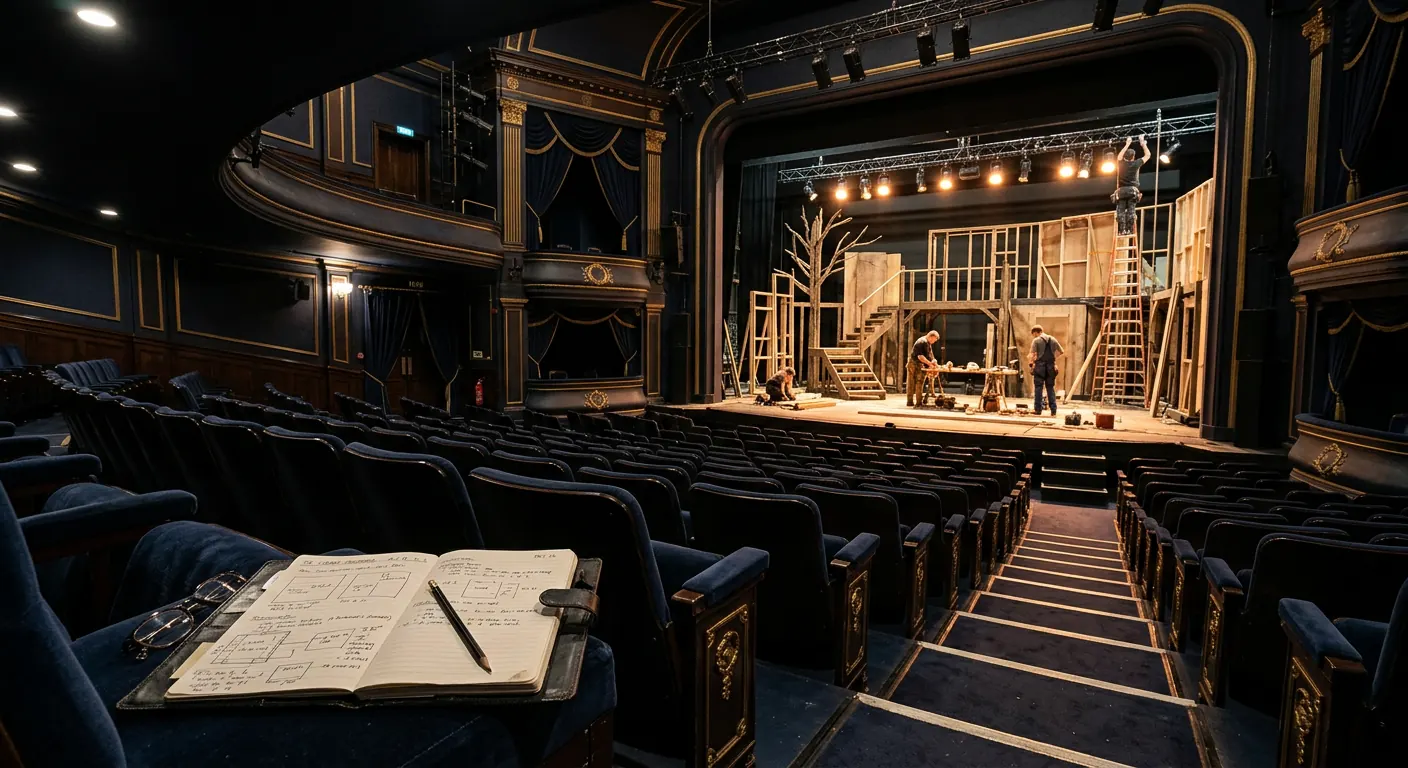
A director's view of a stage under construction

For Directors & Educators

Run a program students remember

You chose the hardest, most rewarding job in the school building. This section is for you: how to pick the show, cast with fairness, plan rehearsals that respect students' time — and how this site can carry part of the teaching load for free.

1

Choosing the right show

The single highest-leverage decision you make all year. The wrong show sinks a program; the right one builds it for a decade.

  • Count your students first, then cast. The show must fit the ensemble you actually have — not the one you wish you had.
  • Balance: does the show give featured moments to more than three students? Programs grow when the ensemble feels valued.
  • Voice parts matter more than hit songs. If you have six strong sopranos and one tenor, pick accordingly.
  • Check the "JR" and "School Edition" catalogues (Music Theatre International, Concord, Broadway Licensing) — they are re-orchestrated and edited for young voices.
  • Read rights and budgets early. Royalties for a school production typically run a few hundred to a couple thousand dollars — plan for it at the start of the year, not the month before.
  • Consider your community: content, length, and runtime should fit your audience and your school's guidelines.
2

Casting fairly (and smartly)

Casting is matching, not ranking. Handle it transparently and your program earns trust for years.

  • Publish your audition expectations in advance: song cut length, whether sides are provided, dance call difficulty, and how callbacks work.
  • Use a scoring rubric (preparedness, vocal technique, movement, character choice, direction-taking) and stick to it — it protects you and the students.
  • Cast for the year, not just the show: who is ready for a stretch? Who needs a win? Growth is the point.
  • Never cast a role a student is unsafe in — a strained voice or injured body teaches nothing good.
  • Post the cast list with a growth note to every student, not just the leads. The ensemble reads those notes too.
  • Have a real conversation with every senior who did not get the role they wanted. Those conversations keep students in the program.
3

A rehearsal plan that works

Eight weeks is enough if you plan backwards from opening night. Here is the frame most successful school programs use.

  • Weeks 1-2: music first. Learn the score as a company before anyone blocks a step — it pays back tenfold.
  • Week 3: table read and blocking the big numbers. Get the whole cast used to the shape of the story.
  • Weeks 4-5: scene work and choreography in rotating groups. Never run the full show twice in a row this early.
  • Week 6: full runs with stopping notes. Track notes per student so no one is corrected only in front of the whole cast.
  • Week 7: runs without stopping (or minimal). Bring in the crew for real transitions.
  • Week 8: tech. Lights, sound, costumes, quick changes — expect it to be rough, and build in rest days. Tired casts get hurt.
  • Protect one day per week with NO rehearsal. Burned-out students quit; rested ones keep coming back.
4

Sending students to THIS site

The Musical Theater Lab is free, safe, and built to make your job easier. Point your cast here and rehearsals get easier.

  • The Labs page teaches the daily technique you wish they already knew — breath, character work, marking choreography.
  • The Practice Log gives every student a streak and goal system, with no accounts and no data collected. Assign practice minutes and check their printout.
  • The Checklists page has audition-week and tech-week checklists — post the link on your call board.
  • The Rep Book page walks students through building an audition binder with printable templates. Students with binders are easier to cast.
  • The Glossary ends the "what does downstage mean" interruptions forever.
5

Advocating for your program

The arts fight for budget every year. The strongest advocates are informed students and parents.

  • Track everything: attendance, hours, students served, and academic gains. Numbers protect programs.
  • Invite administrators to tech week — not just opening night. Let them see the machine they are funding.
  • Publish student wins (All-State, Thespian Festival, scholarships) in your school newsletter.
  • Partner with your feeder middle school: bring their eighth-graders to a matinee every year.
  • Register your troupe with the Educational Theatre Association / International Thespian Society if you have not — the honor society makes advocacy institutional.

Licensing & program resources

Every production requires performance rights from the licensor. These organizations are the standard starting points for American school programs.

Music Theatre International (MTI)

The largest licensor — home of Broadway JR and School Editions built for young performers.

Concord Theatricals

Licensor for Rodgers & Hammerstein, Sondheim, and a deep catalogue of Golden Age work.

Broadway Licensing / Dramatists Playwrights

Strong catalogue of contemporary shows and plays with flexible school rights.

Educational Theatre Association (EdTA)

The International Thespian Society's home — advocacy, festivals, and educator resources.

Theatrical Rights Worldwide (TRW)

Licensor for shows like The Addams Family, Memphis, and The Color Purple.

Print the checklists for your call board

Every checklist on this site — audition week, audition day, callbacks, tech week — can be printed and posted, or sent home with your cast.

Open the Checklists